| |
Overview
Our
KinAce platform represents the first practical use of the human genomics
database to systematically generate drug candidates that target protein
kinases. Our computer algorithms enable Keryx to analyze genomic data in
order to rapidly create compounds that aim to regulate kinases.
Keryx's
approach has already produced 13 lead drug compounds, all of which have
shown biological activity, with nine already demonstrating positive results
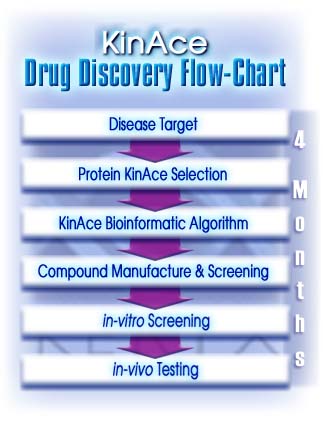
in in vivo testing. It has taken us an average of approximately
four months to develop a drug candidate from concept to in vivo
testing.
Scientific
Background
Cells
communicate with each other to coordinate growth and differentiation. The
primary mechanism by which cells communicate is a messenger system comprising
the transmission of biochemical signals. Protein kinases mediate this process,
known as signal transduction, in multicellular organisms.
Scientists
have estimated that over 1,100 distinct protein kinases exist in the human
genome. They may be present as membrane receptors or located inside the
cell and act in biochemically important roles. Agents which can modulate
the activity of protein kinases have the potential to treat a wide variety
of medical conditions.
Our
KinAce platform technology develops small compounds designed to inhibit
or stimulate the activity of a specific kinase.
Advantages
of the KinAce Approach
We believe that our KinAce platform has the following advantages
over traditional drug discovery methods:
- Increased
hit rate.
Our KinAce platform identifies specific kinase regions and once targeted
it is easier to determine which compound will have the desired effect
on that region. Accordingly, we are able to focus our efforts on only
ten to twenty compounds for testing per kinase target.
- Reduced
time to discovery.
Our approach enables us to generate compounds in an average time,
from concept to in vivo testing, of approximately four
months. In contrast, the industry standard using high throughput
screening ranges from two to four years.
- Reduced
toxicity.
We believe the increased specificity of our drug candidates should result
in less toxicity. Our drug candidates are designed to regulate a region
unique to a particular kinase and cause biological changes that are specific
to the functions of that kinase alone. Other drug discovery methods target
a region that is common to many kinases and consequently are more likely
to also cause additional toxic and potentially dangerous effects.
- Greater
versatility.
We believe that our ability to stimulate, as well as inhibit, protein
kinases makes our drug candidates more versatile in the treatment of diseases
and other abnormal conditions than the compounds of our competitors which
typically aim only to inhibit kinase activity.
|
|